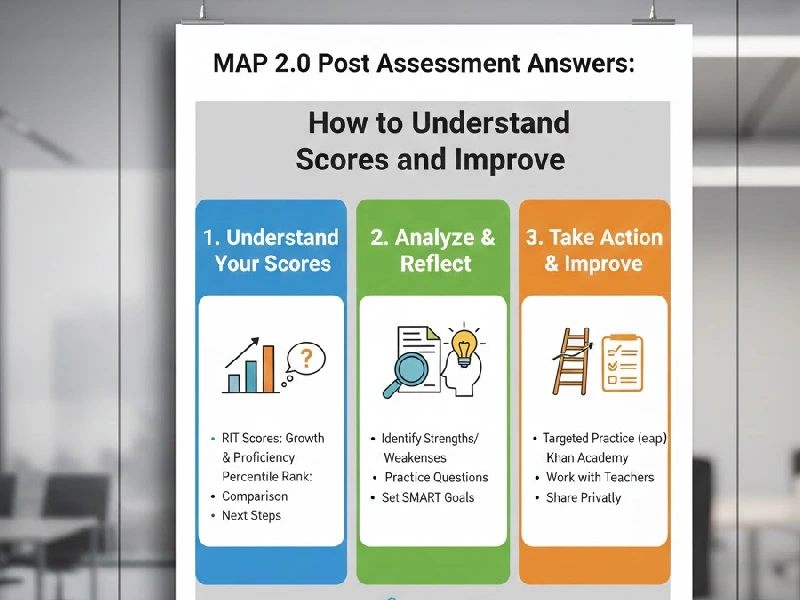
When students, parents, or teachers search for Map 2.0 post assessment answers, they often hope to find a simple list of correct answers for the test. The reality is very different. These “answers” actually refer to detailed feedback, growth metrics, and instructional insights provided after completing a MAP Growth (MAP 2.0) assessment. In this article, you’ll learn what MAP 2.0 post assessment answers are, why there is no universal answer key, and how to interpret your results to support real learning and progress.
What Are MAP 2.0 Post Assessment Answers?
In short, MAP 2.0 post assessment answers are not a traditional answer key. Instead, they provide interpretive results that show where a student stands in reading, math, or language usage and which skills need improvement.
MAP Growth tests are adaptive. This means that the questions each student sees change depending on how previous questions are answered. A student who answers questions correctly receives more challenging questions, while incorrect answers lead to easier ones. Because each test is unique, no two students see the same questions, so no universal answer key exists.
Why There Is No Universal Answer Key
Imagine two students taking the same test. Even if the test is labeled “MAP 2.0,” each student’s test path is different. This adaptive system ensures that the test accurately measures a student’s true instructional level instead of memorized knowledge. Sharing fixed answers would defeat the purpose of an adaptive test and could compromise fairness and accuracy.
What You Actually Receive After a MAP 2.0 Assessment
Instead of a list of correct answers, students and educators receive a detailed report highlighting key areas:
RIT Score — Your Instructional Level
The RIT score (Rasch Unit) measures a student’s academic ability on a continuous scale. Higher RIT scores indicate readiness for more complex material. Comparing scores over time shows growth rather than just a static performance snapshot.
Percentile Rank — How You Compare Nationally
Percentile ranks indicate how a student’s performance compares to peers nationwide. A 50th percentile score means average performance, while a 75th percentile score indicates above-average performance. This gives context to your growth and achievement relative to a broader population.
Instructional Areas — Skills You Have or Need
Post-assessment reports break down performance into instructional areas such as algebraic thinking, reading comprehension, or vocabulary. This shows strengths and skill gaps, helping students and teachers focus on targeted learning instead of memorizing answers.
How to Use Post Assessment Feedback
Understanding your post assessment answers isn’t about checking a score. It’s about using the data to make meaningful educational decisions.
For Students
Instead of stressing about memorizing answers, look at patterns in your performance report. If your RIT score increased compared to the previous assessment, you’re making real progress. If an area like reading comprehension shows little growth, focus practice on those skills — for example, analyzing texts, summarizing main ideas, or practicing problem-solving.
For Parents
Reports provide a roadmap for supporting your child at home. Discuss instructional areas with teachers and use the results to guide practice in reading, math, and vocabulary. Targeted practice is far more effective than a generic study.
For Teachers
Teachers use MAP Growth reports to group students for targeted instruction, identify areas needing reteaching, and adjust lesson pacing to match students’ instructional needs. The focus is on growth and skill development rather than competition.
Common Misconceptions About MAP 2.0 Post Assessment Answers
Many searches come from misunderstandings about MAP 2.0:
-
“There’s a secret answer key.”
No. The test is adaptive, so every student receives a unique set of questions. -
“Higher scores mean smarter students.”
RIT scores measure instructional level and growth over time, not intelligence. -
“I can prepare by memorizing past answers.”
Memorizing answers won’t help because next year’s test will be different. Focus on understanding key concepts.
Preparation Tips — What Actually Helps
Since there is no fixed answer key, the most effective preparation focuses on skill building:
-
Review core subject skills: Practice reading comprehension, algebra, and problem-solving.
-
Practice adaptive-style questions: Familiarize yourself with questions of varying difficulty.
-
Use feedback wisely: Concentrate on weaker instructional areas identified in previous reports.
Frequently Asked Questions
Q1. Are there official MAP 2.0 post-assessment answers available online?
A: No. MAP Growth is adaptive, so no universal answer key exists.
Q2. What do MAP 2.0 results show?
A: They show RIT scores, percentile ranks, and instructional area feedback.
Q3. How can I improve my MAP performance next time?
A: Focus on strengthening foundational skills instead of memorizing answers.
Q4. Does a higher RIT score mean I did better than everyone else?
A: It reflects performance relative to national norms, not necessarily compared to classmates.
Q5. Can I use past MAP answer lists to prepare for future tests?
A: No. Adaptive tests present unique questions, so old answer lists are not useful.
About the Author