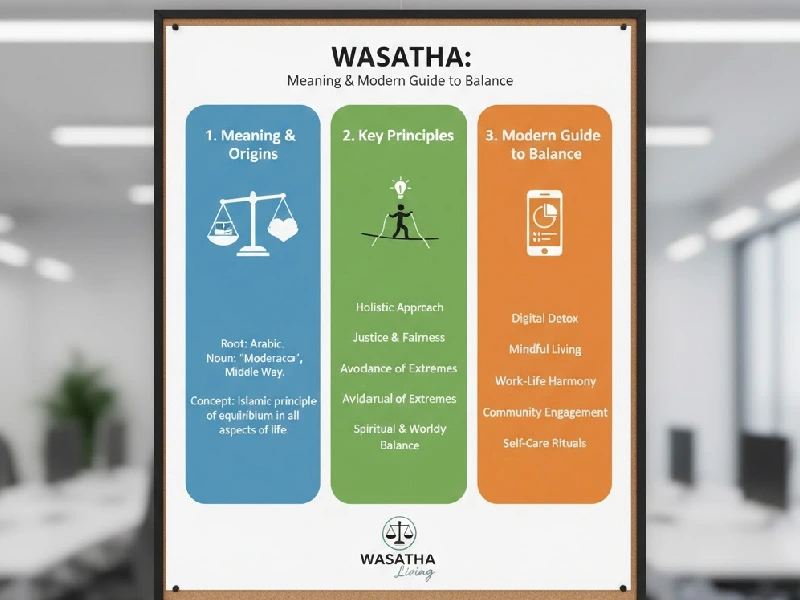
In a world full of extremes and rapid changes, the concept of wasatha has gained renewed attention. But what does wasatha really mean? Derived from Arabic, it literally refers to the middle, balance, or moderation. Beyond its linguistic roots, wasatha has deep cultural, ethical, and religious significance. Today, it is applied not just in spiritual life but also in personal decisions, leadership, and social harmony. Understanding this principle can help you navigate challenges with fairness, thoughtfulness, and integrity.
Whether you’re curious about its origin, its mention in the Quran, or how to apply it in daily life, this article provides a comprehensive guide. By the end, you’ll understand why wasatha is more than a concept — it’s a way of thinking and living.
What Is Wasatha? A Clear Definition
At its core, wasatha comes from the Arabic root wasat, meaning “middle” or “center.” It embodies the idea of balance, fairness, and moderation. People often confuse it with neutrality or indecision, but wasatha is active, intentional, and deliberate. It emphasizes taking the middle path between extremes — whether in thought, behavior, or judgment.
In practical terms, wasatha encourages avoiding excesses and deficiencies. For example, being overly harsh or overly lenient can lead to imbalance, whereas practicing wasatha ensures fair and just actions. This principle guides both individual conduct and community interactions, making it relevant across personal, professional, and social contexts.
Wasatha in Arabic and Linguistic Roots
The Arabic word wasat literally translates to “middle” or “center.” Over time, it has expanded to convey balance, fairness, and ethical moderation. Several related terms reinforce its meaning:
-
Wasathiyah: The practice of moderation
-
Tawassuth: Mediating or being moderate
-
I’tidal: Uprightness and balance
Traditional Arabic dictionaries describe wasatha as the state of being in the most favorable position, not leaning toward extremes. It represents wisdom, fairness, and proportion, serving as a guiding principle for behavior and judgment.
How Traditional Sources Use Wasatha
Classical lexicons and Quranic exegesis highlight wasatha as the ideal position between extremes. For instance, a ruler who practices wasatha governs with justice, not favoring one side excessively. Similarly, in personal ethics, wasatha encourages actions that balance desires with responsibility.
Wasatha in the Quran: Moderation as a Principle
One of the most significant mentions of wasatha is in the Quran, in Surah Al‑Baqarah (2:143):
“And thus We have made you a just community (ummatan wasatha), that you will be witnesses over mankind and the Messenger will be a witness over you.”
Here, wasatha signifies a balanced, moderate, and just community. Scholars like Quraish Shihab explain that this means a group that maintains fairness in social, spiritual, and worldly matters.
Key Quranic Nuances
-
Spiritual vs Worldly Balance: Wasatha encourages believers to maintain equilibrium between spiritual devotion and worldly responsibilities.
-
Avoiding Excess or Deficiency: Extremes in behavior, wealth, or piety are discouraged, while measured conduct is praised.
-
Active Engagement: Wasatha is not passive neutrality; it is conscious participation in shaping a just society.
By understanding this verse, one realizes that wasatha is both a moral and social principle, guiding communities toward fairness and cohesion.
Wasatha vs Extremes: What It Is and Isn’t
It’s important to clarify what wasatha does not mean.
-
Not passivity or indecision: Wasatha requires deliberate action, not avoidance.
-
Not compromise at the cost of principles: It balances extremes without abandoning core values.
-
Not weakness: Strength is exercised within moderation, not through force or suppression.
For example, in conflict resolution, wasatha encourages dialogue and fairness rather than domination or complete concession. A leader applying wasatha makes decisions that are just, measured, and effective.
| Misconception | Reality |
|---|---|
| Moderation = no stance | Moderation = balanced, deliberate stance |
| Middle = compromise | Middle = active fairness without losing values |
| Neutrality = wasatha | Wasatha = conscious, ethical engagement |
Seven Characteristics of Wasatha Thinking
Understanding wasatha becomes easier when broken into practical traits:
-
Proportional Judgment — weighing options fairly without favoring extremes.
-
Stability Over Reactivity — responding thoughtfully rather than impulsively.
-
Fair Evaluation — assessing situations without bias or prejudice.
-
Ethical Restraint — exercising self-control in behavior and decisions.
-
Balance Between Material and Spiritual — giving importance to both worldly needs and moral duties.
-
Respect for Diversity — recognizing multiple perspectives without extreme rigidity.
-
Long-term Thinking — considering consequences beyond immediate gains or losses.
These traits are visible in ethical leaders, balanced communities, and individuals striving for personal development.
How Wasatha Applies in Daily Life
Wasatha is not just a theoretical concept; it has practical applications in everyday life.
Personal Life
-
Work-life balance: Prioritize responsibilities without neglecting personal well-being.
-
Emotional moderation: Respond to challenges with calm and measured reactions.
-
Decision-making: Avoid impulsive choices; analyze pros and cons carefully.
Social & Community Context
-
Balanced leadership: Ensure fairness in governance or group management.
-
Fair dialogue: Engage in discussions that respect all opinions.
-
Coexistence: Promote harmony in diverse communities by avoiding extreme stances.
Education & Knowledge
-
Critical thinking: Evaluate information carefully, without bias.
-
Respect tradition while embracing innovation: Apply ethical balance when combining old and new ideas.
Practical examples include choosing ethical investments, negotiating workplace conflicts, or participating in civic duties with fairness and thoughtfulness.
Wasatha in Modern Thought and Organizations
Modern thinkers and organizations have embraced wasatha as a guiding principle.
-
Muhammadiyah and Wasathiyah: Muhammadiyah, a major Islamic organization, emphasizes moderate Islam to promote balance, justice, and social responsibility.
-
Abdul Mu’ti’s Five Aspects: Goodness, balance, justice, avoidance of extremes, and social contribution form the core of modern wasatha interpretation.
-
Global Relevance: Moderation can guide governance, conflict resolution, and social harmony in pluralistic societies.
By applying wasatha, organizations and leaders foster inclusivity and fairness while avoiding polarization and radicalism.
Common Misconceptions About Wasatha
Even though wasatha is widely referenced, misconceptions persist:
-
Moderation means no stance: False. Wasatha is active and principled.
-
Balance equals compromise: False. It balances values without abandoning ethics.
-
Middle path avoids deep conviction: False. Wasatha can coexist with strong beliefs, applied wisely.
By understanding these myths, individuals can apply wasatha effectively in both personal and societal contexts.
FAQs
-
What does wasatha literally mean?
Answer: It comes from Arabic wasat, meaning middle, balance, or fair. -
Is wasatha the same as moderation?
Answer: Broadly yes, but it emphasizes intentional fairness and balance. -
Where is wasatha mentioned in the Quran?
Answer: Surah Al‑Baqarah (2:143) refers to a just and balanced community. -
Can wasatha be applied outside religion?
Answer: Absolutely — it’s a universal principle of ethical balance and judgment. -
Is wasatha the same as neutrality?
Answer: No. Neutrality is passive, while wasatha is an active, balanced engagement.
About the Author