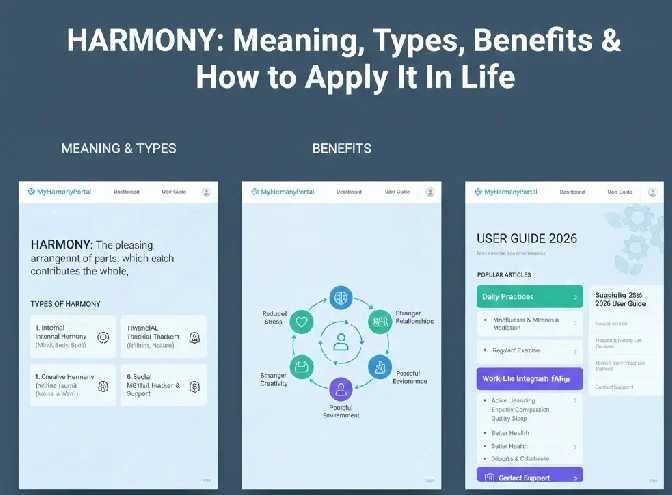
Harmony is a word we hear every day in songs, in happy relationships, and in peaceful places, but what does it truly mean? At its core, harmony is the way parts come together in agreement and balance. Whether you’re listening to a choir, decorating a room, or navigating team dynamics, harmony reflects unity and coherence that feels pleasing, stable, and effective.
Rooted in the Greek word harmonia, meaning “agreement and joining,” harmony goes beyond sound to describe any situation in which diverse elements fit together without conflict. In this deep dive, we’ll explore harmony in its most common forms: musical, social, visual, and psychological — and show how understanding it can enhance your life in meaningful ways.
What Is Harmony?
Harmony refers to the pleasing combination of parts working together in a balanced way. In music, it’s the way notes blend to form chords; outside music, it can describe people living peacefully, colors that complement one another, or ideas that align smoothly.
At its simplest, harmony is agreement and cooperation. A group operating in harmony gets things done with less friction. Harmony in nature feels peaceful among colleagues, creates collaboration within yourself, and brings emotional calm.
Core Concepts of Harmony
-
Agreement or Concord: Different elements agree instead of clashing.
-
Pleasing Arrangement: Parts combine in a way that feels right or balanced.
-
Unity in Diversity: Even when elements differ, they fit together in a complementary way.
Think of harmony as alignment everything moves in sync rather than resistance.
Harmony in Music: The Musical Foundation
Most people encounter the word “harmony” first in a musical setting. In music, harmony means notes sounding together to produce a smooth and pleasing effect. It’s about how chords and progressions support the melody to make music feel rich and expressive.
Harmony isn’t just noise; it’s structured sound. Musicians study harmony to understand how chords relate, resolve, and create emotions. Chords themselves are combinations of notes (like a basic triad with a root, third, and fifth) that form the harmonic backbone of a song.
Basic Types of Musical Harmony
-
Consonant Harmony — Sounds that feel smooth and stable.
-
Dissonant Harmony — Tension‑creating notes that want resolution.
-
Chromatic Harmony — Includes notes outside a basic key for emotional depth.
-
Close vs Open Harmony — Notes spaced narrowly vs widely.
Harmony influences the mood of music. A calm song may rely on gentle consonances; a dramatic piece may use dissonance for emotional tension.
Beyond Sound: Harmony in Life & Relationships
Harmony isn’t just musical — it’s social. When people agree, collaborate, and share mutual respect, they exist in harmony. In relationships, harmony means two people work toward shared goals without excessive conflict.
On a larger scale, social harmony describes peaceful coexistence among different groups. Harmony in this sense reduces friction and promotes cooperation.
Harmony vs Conflict
Conflict disrupts rhythm; harmony fosters growth and stability. In teams, harmony enhances communication and productivity. In families, harmony builds trust and emotional bonds.
Visual Harmony: Color & Design
Harmony isn’t limited to sound or society. In visual arts and design, harmony describes pleasing combinations of visual elements, especially color. A color palette with balanced tones feels just right — visually satisfying and coherent.
Popular Color Harmonies
-
Complementary Colors: Opposites on the color wheel that balance contrast.
-
Analogous Colors: Neighboring hues that feel smooth together.
-
Triadic Colors: Three evenly spaced hues that provide vibrant balance.
The Psychology of Harmony
Psychologically, harmony also refers to inner balance — when your thoughts, emotions, and actions are aligned. People who feel harmony internally often report better well-being and a greater sense of peace.
Some research suggests that harmony across life domains, work, family, and personal goals, contributes to overall satisfaction and happiness. Harmony doesn’t mean no challenge; it means your responses and environment aren’t constantly at odds with your inner needs and values.
Conclusion
Harmony is a powerful principle we encounter in music, life, design, and psychology. It shows how elements, whether notes in a chord, people in a group, or colors in a palette, can complement one another in ways that feel natural and pleasing.
Understanding harmony helps you create better music, relationships, spaces, and inner balance. It teaches that diversity, when aligned thoughtfully, produces richer and more meaningful experiences.
FAQ
1. What does harmony mean?
Harmony is the way separate elements come together in agreement or balance, often creating a pleasing effect in music, life, or design.
2. How is harmony different from melody?
Melody is a sequence of single notes forming a tune; harmony involves those notes being combined to support or enrich the melody.
3. What are the key types of harmony in music?
Common types include consonant (smooth), dissonant (tense), chromatic (rich), and spatial distinctions like open vs close harmony.
4. Can harmony exist in non‑musical contexts?
Yes — harmony can describe social relationships, visual design balance, and internal emotional states.
5. Why is color harmony important in design?
It creates balanced and aesthetically pleasing visuals that feel intentional rather than jarring.
About the Author