Nucleotides are some of the most powerful yet misunderstood molecules in the human body. Every breath you take, every thought you form, and every cell that divides relies on them. If you’ve ever wondered what nucleotides are, how they work, and why they’re essential, this guide breaks it all down clearly.
In this complete explanation, you’ll learn how nucleotides build DNA and RNA, fuel cellular energy through ATP, support immunity, and even play a role in nutrition and recovery. No fluff. No jargon overload. Just real biology explained as a smart friend would.
What Are Nukleotidy? (Clear & Simple Definition)
Nucleotides are the basic building blocks of DNA and RNA.
They are small organic molecules that store genetic information and enable cellular communication and energy transfer.
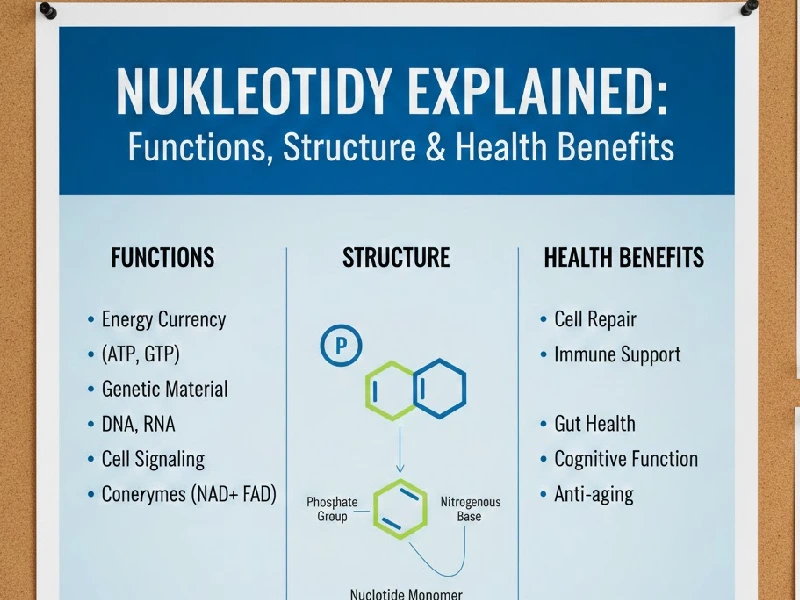
Each nucleotide is made of three essential parts:
-
Nitrogenous base (adenine, guanine, cytosine, thymine, or uracil)
-
Sugar molecule (ribose or deoxyribose)
-
Phosphate group
When millions of nucleotides link together, they form long chains that carry genetic instructions and power vital processes inside every living cell.
Without nucleotide:
-
DNA could not exist
-
Cells could not reproduce
-
Energy production would collapse
They are, quite literally, non-negotiable for life.
Nucleoside vs Nucleotide: What’s the Difference?
This is a common point of confusion.
-
Nucleoside = base + sugar
-
Nucleotide (nukleotyd) = base + sugar + phosphate
That single phosphate group makes all the difference. It allows nucleotides to:
-
Bond into DNA and RNA strands
-
Store and release energy
-
Act as signaling molecules
Think of nucleosides as inactive parts and nucleotides as the fully powered version.
How Nucleotides Build DNA and RNA
DNA and RNA are nothing more than organized chains of nucleotides.
DNA (Deoxyribonucleic Acid)
-
Built from deoxyribonucleotides
-
Uses bases: A, T, C, G
-
Forms a double-helix structure
-
Stores permanent genetic information
RNA (Ribonucleic Acid)
-
Built from ribonucleotides
-
Uses bases: A, U, C, G
-
Single-stranded
-
Helps translate genetic instructions into proteins
Each nucleotide connects through its phosphate group, forming a backbone that holds genetic data in perfect sequence. One small error in nucleotide order can change how a protein works — or whether it works at all.
That’s how precise and powerful nucleotides are.
Core Biological Functions of Nucleotides
Nucleotides are far more than genetic bricks. They are multifunctional workhorses inside cells.
1. Genetic Information Storage
DNA nucleotides store instructions for:
-
Cell growth
-
Tissue repair
-
Enzyme production
-
Inherited traits
Every cell carries the same DNA, yet different nucleotide sequences control different functions.
2. Cellular Energy Production (ATP System)
One nucleotide deserves special attention: ATP (adenosine triphosphate).
ATP is the primary energy currency of the cell.
-
Built from a nucleotide base and three phosphate groups
-
Breaking one phosphate bond releases energy
-
Powers muscle contraction, nerve signals, and metabolism
Every second, your body uses and regenerates billions of ATP molecules. No nucleotides means no energy. Period.
3. Cell Signaling & Communication
Some nucleotides act as chemical messengers.
Examples include:
-
cAMP
-
cGMP
These molecules:
-
Transmit signals inside cells
-
Regulate hormones
-
Control enzyme activity
In short, nucleotides help cells talk to each other and respond intelligently. Nucleotides in Human Health & Nutrition
Your body can produce nucleotides on its own, but under certain conditions, dietary nucleotides become extremely important.
Natural Sources Nucleotides
-
Meat and poultry
-
Fish and seafood
-
Yeast extracts
-
Dairy products
These foods provide ready-to-use nucleotides that support rapid cell turnover.
Role in Immune Function
Immune cells divide and activate quickly. That process demands a steady nucleotide supply.
Adequnucleotide help:
-
Support immune cell growth
-
Improve response to stress
-
Aid recovery after illness
This is why nucleotide supplementation is often studied in infants, athletes, and people recovering from infections.
Gut Health & Tissue Repair
The digestive tract renews itself rapidly. Nucleotide assisted by:
-
Supporting intestinal cell regeneration
-
Enhancing nutrient absorption
-
Maintaining gut barrier integrity
Healthy cells need fast DNA replication — and that requires nucleotides.
Do You Ever Need Nucleotide Supplements?
For most healthy adults, diet and internal synthesis are enough. However, supplementation may be useful during:
-
Rapid growth phases
-
Physical overtraining
-
Recovery from illness or surgery
-
Digestive stress
Nucleotide supplements typically contain blends of:
-
AMP
-
GMP
-
CMP
-
UMP
These are absorbed and reused efficiently by the body.
They aren’t magic pills, but in the right context, they can support recovery and resilience.
Common Myths About Nucleotides
Myth 1:Nucleotidesy are only about DNA
False. Energy, signaling, immunity, and metabolism all depend on them.
Myth 2: You don’t need dietary nucleotides
Mostly true, but not always. Demand sometimes exceeds production.
Myth 3: All nucleotides are the same
Each has unique biological roles and functions.
WhNWhen Nucleotidestter More Than You ThiNucleotidesidy sit at the crossroads of:
-
Genetics
-
Energy production
-
Cellular repair
-
Immune defense
They quietly run the systems that keep you alive and functional. Once you understand their role, it becomes clear why biology treats them as non-replaceable molecules.
Frequently Asked Questions (FAQ)
What exactly nucleotidestNucleotidesotidy are organic molecules made of a nitrogen base, sugar, and phosphate that form DNA, RNA, and energy carriers like ATP.
Hnucleotideseotidy produce energy?
They form ATP. When ATP loses a phosphate group, energy is released to power cellular functions.
Are nucleosides and nucleotides the same?
No. Nucleosides lack a phosphate group. Adding phosphate turns them into active nucleotidenucleotidesleotidy improve immunity?
They support immune cell growth and function, especially during stress or recovery periods.
Are nucleotide supplements safe?
When used appropriately, they are generally well-tolerated and biologically compatible.
Final nucleotides are small mmoleculeswith ma assive impact. They write your genetic code, fuel your cells, and help your body adapt and heal. Understanding them isn’t just biology — it’s insight into how life actually works.
If DNA is the blueprint, nucleotides are the ink, paper, and electricity that make everything run.
About the Author