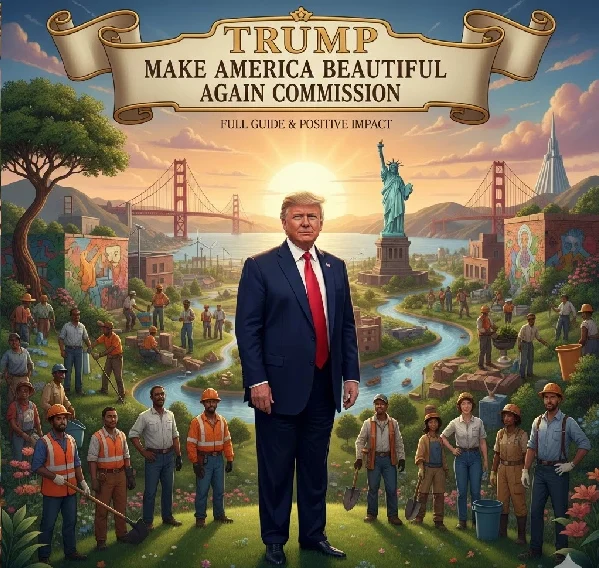
The Trump Make America Beautiful Again Commission represents one of the most ambitious and politically charged federal initiatives focused on public land access, conservation philosophy, and outdoor recreation policy in recent years. Created through executive authority, the commission aims to redefine how America manages its natural resources while framing conservation as a matter of national pride, freedom, and economic strength.
At its core, the commission blends environmental stewardship with deregulation, emphasizing access over restriction and voluntary conservation over enforcement. Supporters describe it as a bold reset. Critics see it as a risky experiment. Either way, the Trump Make America Beautiful Again Commission has sparked nationwide discussion and reshaped the conservation debate.
This guide breaks down what the commission is, why it exists, how it operates, who supports it, who opposes it, and what it realistically means for everyday Americans.
What Is the Trump Make America Beautiful Again Commission?
The Trump Make America Beautiful Again Commission is a federal coordinating body established by executive order to align public land management, outdoor recreation, and conservation priorities under a single strategic framework.
Rather than functioning as a traditional regulatory agency, the commission operates as a policy-driving and advisory mechanism. Its mission is to guide federal departments toward policies that expand access to public lands, encourage recreational use, and promote conservation efforts without expanding federal control.
Key Characteristics of the Commission
-
Operates at the executive level
-
Coordinates multiple federal agencies
-
Focuses on access, recreation, and stewardship
-
Prioritizes voluntary conservation models
-
Emphasizes the economic and cultural benefits of nature
Unlike past conservation programs centered on preservation and restriction, this commission frames conservation as use, appreciation, and responsibility, not limitation.
Why Was the Make America Beautiful Again Commission Created?
The Trump administration argued that America’s natural beauty was being underutilized, overregulated, and disconnected from everyday citizens. According to this perspective, excessive bureaucracy limited recreation, slowed infrastructure improvements, and discouraged private-public partnerships.
The commission was designed to counter those issues by:
-
Reducing regulatory bottlenecks
-
Expanding land and water access
-
Encouraging local and private stewardship
-
Supporting the outdoor recreation economy
A Shift in Conservation Philosophy
Traditional conservation often relies on strict environmental rules. The commission flips that model by promoting voluntary stewardship driven by incentives rather than mandates.
The underlying belief is simple but controversial:
People protect what they are allowed to enjoy.
Who Leads the Trump Make America Beautiful Again Commission?
The commission is chaired by the Secretary of the Interior, supported by senior officials from several major federal departments. This structure ensures influence across agencies that oversee land, water, wildlife, and infrastructure.
Participating Departments Include
-
Department of the Interior
-
Department of Agriculture
-
Environmental Protection Agency
-
Department of Defense
-
Department of Transportation
By bringing these agencies together, the commission seeks to eliminate fragmentation in land policy and create a unified national direction.
Core Goals of the Trump Make America Beautiful Again Commission
The commission’s goals can be grouped into four major pillars.
1. Expand Public Access to Land and Water
The commission promotes opening more federal lands and waterways for:
-
Hunting
-
Fishing
-
Hiking
-
Camping
-
Boating
-
Trail riding
Supporters argue that access builds public appreciation and strengthens conservation culture.
2. Boost the Outdoor Recreation Economy
Outdoor recreation is a massive economic engine. The commission frames conservation not as a cost but as an economic multiplier.
Key objectives include:
-
Supporting rural tourism
-
Encouraging infrastructure upgrades
-
Creating recreation-related jobs
-
Strengthening local economies
3. Promote Voluntary Conservation
Instead of increasing regulations, the commission supports:
-
Incentive-based conservation programs
-
Public-private partnerships
-
State and tribal collaboration
-
Landowner-led stewardship
This approach aims to make conservation cooperative rather than confrontational.
4. Streamline Federal Land Management
The commission pushes agencies to:
-
Reduce bureaucratic delays
-
Simplify access permits
-
Review outdated policies
-
Coordinate decision-making
This goal resonates strongly with rural communities and outdoor groups frustrated by slow federal processes.
What the Commission Actually Does in Practice
The Trump Make America Beautiful Again Commission does not directly manage land. Instead, it influences how agencies set priorities and implement policies.
Practical Actions Include
-
Reviewing federal access restrictions
-
Recommending policy reforms
-
Encouraging recreational infrastructure projects
-
Supporting conservation partnerships
-
Advising on land-use strategy
Its power lies in coordination, not enforcement.
Support for the Commission: Who Backs It and Why
The commission has earned praise from a broad coalition of outdoor-focused groups, especially those centered on recreation and sportsmanship.
Supporters Often Include
-
Hunters and anglers
-
Outdoor recreation businesses
-
Rural tourism advocates
-
Some conservation partnerships
-
State and local land managers
Why Supporters Applaud the Commission
-
Expands access to public lands
-
Respects local decision-making
-
Encourages economic growth
-
Avoids heavy-handed regulation
-
Recognizes cultural traditions
For many supporters, the commission restores balance between use and protection.
Criticism and Controversy Surrounding the Commission
Despite its popularity among recreation groups, the Trump Make America Beautiful Again Commission faces strong opposition from environmental organizations and policy analysts.
Primary Criticisms
-
Lack of enforceable protections
-
Overreliance on voluntary compliance
-
Increased risk of land degradation
-
Absence of climate-focused policy
-
Political framing over science-driven conservation
Critics argue that good intentions alone cannot replace regulation when ecosystems are fragile.
Climate Concerns
One of the most consistent criticisms is the commission’s limited focus on climate change. Environmental groups argue that ignoring climate pressures weakens long-term conservation outcomes.
Access vs Preservation Debate
Opponents warn that expanded access can:
-
Increase pollution
-
Damage habitats
-
Disrupt wildlife
-
Overcrowd sensitive areas
This debate highlights a central tension: how much access is too much?
How the Trump Make America Beautiful Again Commission Affects Ordinary Americans
The commission’s real impact becomes clear at the local level.
Outdoor Enthusiasts
-
Easier access to public lands
-
More recreational options
-
Improved facilities
Rural Communities
-
Increased tourism revenue
-
Job creation
-
Infrastructure development
Conservation Advocates
-
Greater collaboration opportunities
-
Concerns about enforcement gaps
Private Landowners
-
New conservation incentives
-
Expanded partnership options
Long-Term Impact: What Happens Next?
The lasting influence of the Trump Make America Beautiful Again Commission depends on implementation. Executive commissions shape direction, but results emerge over time.
Possible Outcomes
-
Expanded recreation access nationwide
-
Stronger outdoor economy
-
Mixed conservation results depending on the region
-
Continued political debate
The commission’s legacy may hinge on whether voluntary stewardship can deliver measurable environmental protection.
Common Myths About the Commission
Myth 1: It Eliminates Conservation Rules
False. It shifts emphasis but does not erase existing laws.
Myth 2: It Privatizes Public Lands
False. Lands remain federally owned.
Myth 3: It Only Benefits One Political Group
Oversimplified. Benefits vary by region and use.
Frequently Asked Questions
What is the Trump Make America Beautiful Again Commission?
It is a federal commission created to expand public land access and promote conservation through voluntary, cooperative strategies.
Is the commission still active?
Yes, it continues to influence public land and recreation policy.
Does the commission regulate environmental protection?
No. It coordinates policy but does not create new regulations.
How does it affect national parks?
It emphasizes access and recreation while relying on existing protections.
Why is the commission controversial?
Critics argue it prioritizes access and economic growth over enforceable environmental safeguards.
Final Takeaway: Why This Commission Matters
The Trump Make America Beautiful Again Commission represents a fundamental shift in how conservation is framed in America. Instead of restrictions, it emphasizes access. Instead of enforcement, it promotes cooperation and centralized control, and it favors local involvement.
Whether this approach strengthens or weakens conservation depends on execution. What’s undeniable is that the commission has reshaped the conversation around public lands, outdoor recreation, and national identity.
In a country defined by its landscapes, the debate over how to protect them and who gets to enjoy them is far from over.
About the Author